C19 Americanist Scholar & Teacher
My interests range broadly in the late-18th and 19th centuries and draw upon a variety of disciplinary investments: literary aesthetics; political theory, especially theories of democracy; scales of community and collectivity; and material history, especially book and print culture history. My books are detailed below. Essays and reviews have appeared in American Literature, J19: The Journal of 19th-Century Americanists, ESQ: A Journal of 19th-Century American Literature, Nineteenth-Century Literature, Los Angeles Review of Books, and The Spokesman-Review.
As a teacher, I strive to design mindful learning experiences and foster a dynamic environment promoting an open and democratic exchange of ideas. Students in my courses can expect a variety of methods and activities that spark lively engagement with texts and contexts.
I also direct the Whitworth Honors Program, where we aim to equip students to thrive in the world as it is, develop the world as it should be. Much of this work has motivated the development of the Democracy Lab, a humanities-based research collaborative that provides undergraduate with research, professionalizing, and networking opportunities anchored to strengthening civic engagement.
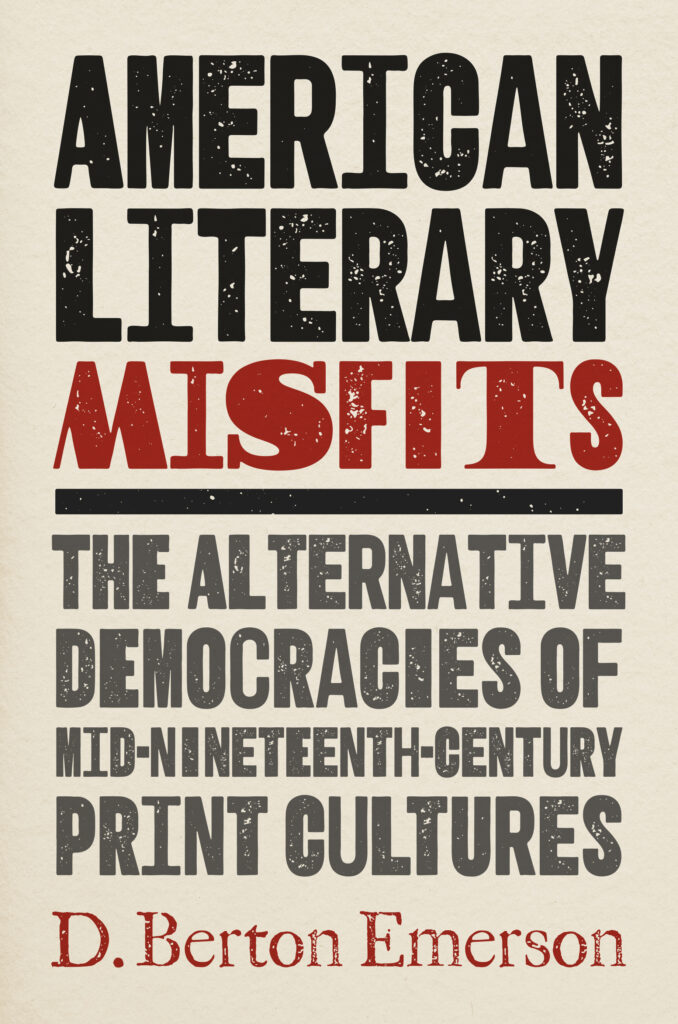
The study of nineteenth-century American literature has long been tied up with the study of American democracy. Just as some regions in the United States are elevated to stand in for the whole nation—New England is a good example—I argue the same is true for American literature of the nineteenth century; a few canonical texts overrepresent the more motley history of American letters. Emerson examines an eclectic group of literary texts that have rarely, if ever, been considered representative of “the nation” because of their unseemly characters or plots, divergence from dominant literary trends of the era, or local particularity. These are his “literary misfits,” authors and texts that show different forms of egalitarianism in action that existed outside and even against the dominant liberal narratives of American democracy.
Emerson’s unique contribution is revealing these texts and the people they represent as rich with political knowledge. This knowledge, he argues, finds its most potent expression in the local. Such texts show us a different kind of democratic politics: one that is egalitarian, disorderly, and radical rather than homogeneous.
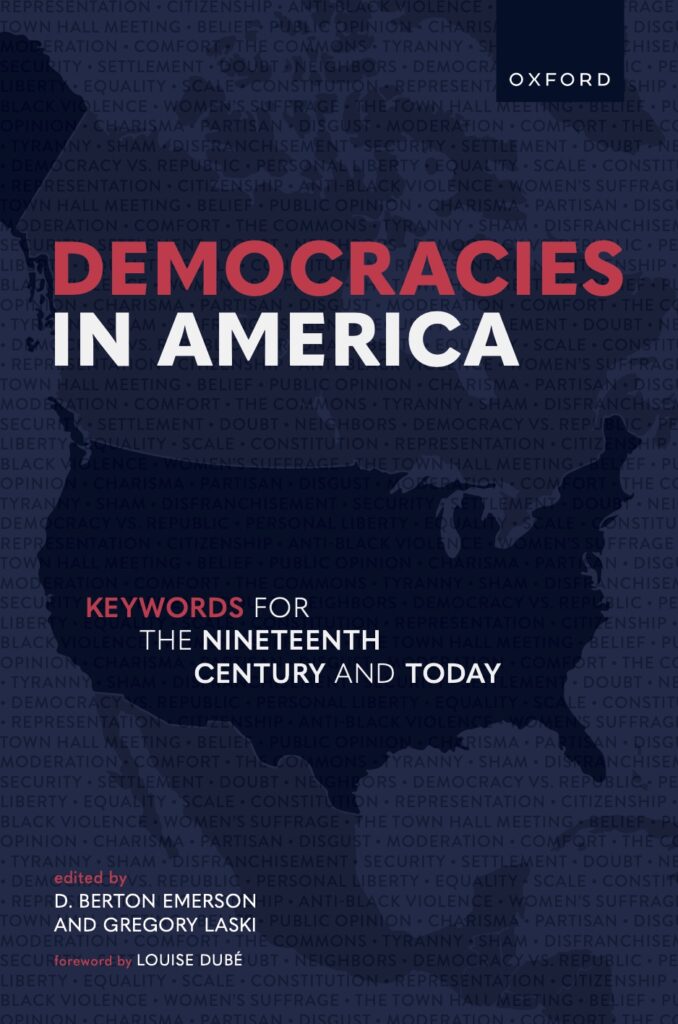
Ask someone their thoughts about “democracy” and you’ll get many different responses. Some may presume it a thing once established yet now under threat. Others may believe that democracy has always been compromised by the empowered few. In the contemporary United States, marked by constituencies across the political spectrum believing that their voices have gone unheard, “democracy” gets wielded in so many divergent directions as to be rendered nearly incoherent.
Democracies in America reminds us that this reality is nothing new. Focusing on the various meanings of “democracy” that circulated in the long nineteenth century, the book collects twenty-five essays, each taking up a keyword in the language we use to talk about democracy. Penned by a group of diverse intellectuals, the entries tackle terms both commonplace (citizenship and representation) and paradigm-stretching (disgust and sham). The essays thus consider the relationship between “America” and “democracy” from multiple disciplinary angles and from different moments in a major historical period-amidst the vitality of the revolutionary epoch, in the contentious lead-up to the Civil War, and through the triumphs and failures of Reconstruction and the early reforms of the Progressive Era-while making both forward and backward glances in time.
The book frames its keywords around a series of enduring democratic dilemmas and questions, and provides extensive resources for further study. Ultimately the volume cultivates, for students and teachers in classrooms, as well as citizens in libraries and cafés, a language to deliberate about the possibilities and problems of democracy in America.