WEEK 6: 6-10 OCTOBER
For Monday (10.6):
- Complete your take-home essay. Bring a printed copy to class as ticket of admission to your exam.
- Prep for exam. Bring your own paper for answers.
- Bring your common-place book to class for a check
Monday, 6 October
Exam #1
For Monday (10.8):
- Read Indigenous Oral and Visual Literatures Intro, Wampanoags (A, 1-4)
- Record two entries in your common-place book
Wednesday, 8 October
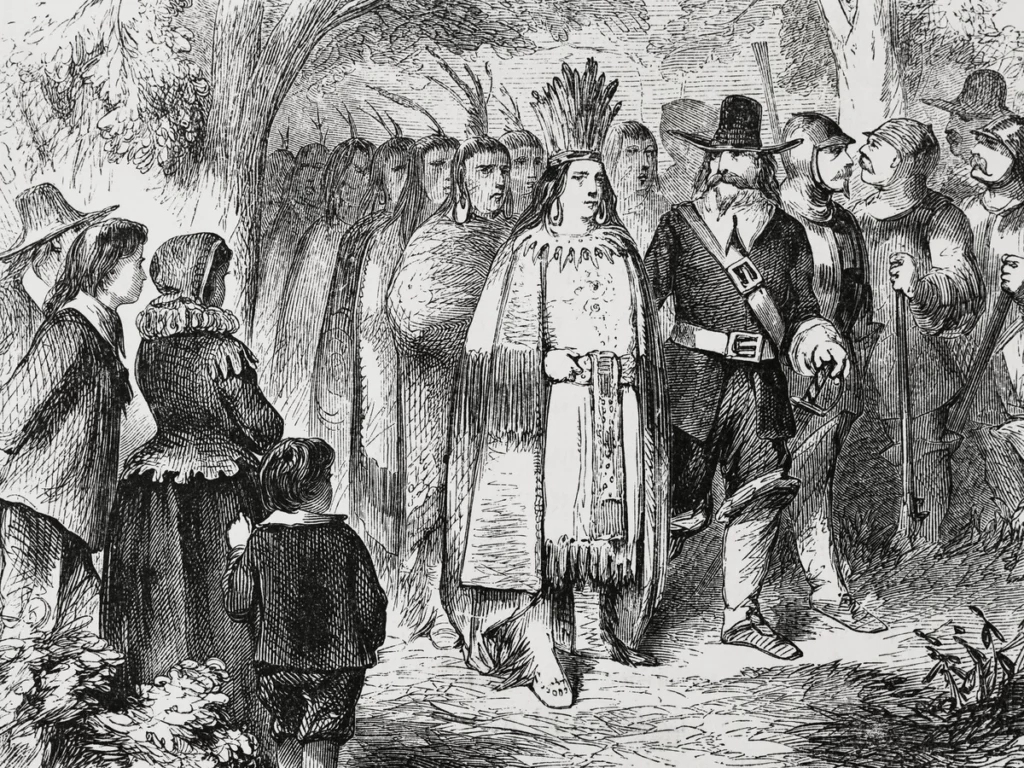
In this unit we shift from tensions between states built upon religious and/or secular principles to a different sort of tension between the conceptualizations and manifestations of freedom and captivity. We kick off this unit with a variety of readings depicting the relationship between Europeans and the indigenous people of North America. We look at selections from the anthology to get an idea of various tropes from Native American culture. With these readings we hope to see the variety of relationships at the heart of questions about freedom—from self-expression and belief systems to multivalent representations and reactionary impulses.
For Friday (10.10):
- Read Rowlandson, The Sovereignty and Goodness of God (A, 285-299)
- Record two entries in your common-place book
Friday, 10 October
Mary Rowlandson (1656-1711) produced the most famous of several early American captivity narratives. Her text, A Narrative of the Captivity and Restoration of Mary Rowlandson, was published in 1682 and read with great avidity (mostly by literate Londoners). Detailing her capture, enslavement, and restoration in 1676 amidst the conflict that came to be known as King Philip’s War, Rowlandson’s narrative offers provocative material for our interests in the dialectic of captivity and freedom in early America. Rowlandson’s narrative stages her conflict quite obviously between English colonizers and indigenous peoples who had long claimed contested land as their home. Herein we see continuities in Rowlandson’s Puritan faith-system, but we also think in more secular terms of political subjectivity and various degrees of freedom and non-freedom. Our focus in this first of two days lies in identifying distinctive voices within the text by looking at some specific passages and thinking through the larger implications as they pertain to captivity, freedom, and self-expression in this late-Puritan context.
For Monday (10.13):
- Read Rowlandson, The Sovereignty and Goodness of God (A, 299-312)
- Record two entries in your common-place book